
I promise there is some Excel in this post – skip to the end if that’s what you’re here for.
This post is about both the book and film versions of Project Hail Mary. I’m making this post spoiler free, but the links I include may contain spoilers so follow at your own risk. When I first read the book a few years back I was lucky to have no prior knowledge about it or any of the plot points, and I think it made it that much more thrilling. So if you have the chance to enjoy either the book or film without knowing anything first, then I don’t want to take that away from you!
Project Hail Mary – the book
It’s quite hard to describe all the things I liked about the book without giving away the plot, so I’ll just summarise it as follows.
It’s hard sci-fi with a soft heart.
That is, there’s lots and lots of physics, maths, biology and scientific experimentation throughout, which makes the reader feel clever. (And it is genuinely educational – I do actually understand the theory of relativity and light waves better now!)
At the same time there’s an incredibly sweet story at its core, designed to tug at the heartstrings in various places.
It made me laugh and cry and want to be a better person. I also couldn’t put it down – which was awkward as I wasn’t reading a physical copy, I was listening to the legendary audiobook version narrated by Ray Porter. I have a memory of being at an event and then sneaking off for a quiet half an hour in the canteen so I could just listen to another chapter of it.
And when I got to the end – I just had to listen to the final chapter again immediately afterwards.
Project Hail Mary – the film
I’m sure I’m not the only reader to be a bit nervous about how a film could do it justice. The audiobook is 16 hours long; the film is a toppy 2.5 hours. So obviously lots of it would need to be cut or summarised.
I certainly didn’t expect to love the film as much as the book. But I’ve now seen it three times and maybe I do?
The first time I watched it I was mostly comparing it to the book. Thoughts like “That line wasn’t in the book” or “shame they had to cut that bit out” or “will this make sense to someone who hasn’t read the book?” were all thoughts I had at various points, and they got in the way of enjoying the film. A teeny bit. I still loved it.
My partner, who’s never read the book, also enjoyed it. And once I’d interrogated him on the various plot points and satisfied myself that it still made sense to him with all the science bits cut out I went back to the cinema and enjoyed it as a piece of film-making in its own right. And then did it again a couple of weeks later.
There’s even a couple of things I prefer in the film. In particular, Sandra Hüller brings an amazing depth to Eva Stratt that just wasn’t there in the book. She’s just as determined and ruthless but also has a heart.
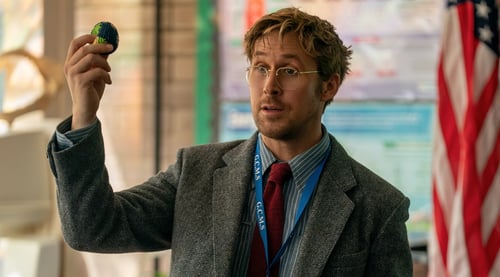
And there were things that I didn’t like first time I watched it but improved on further viewing. For example, early on when Grace wakes up in the spaceship, Ryan Gosling’s portrayal of him is much less together and rational than the book version. In the film, he’s jumpy and fearful and on the verge of a breakdown. But when I rewatched it, I wondered whether the film version was a more plausible reaction for that character.
Multiple viewings, multiple interpretations.
Social media tells me that lots of people seen the film multiple times. This post resonated the most with me (contains spoilers) about why the film has been so popular. Exactly like the book – it made me laugh and cry and want to be a better person.
I’ve also really appreciated some of the criticism of the film (and by extension the book). Again, hard to get into specifics without spoilers but it’s made me think a lot about it and about alternative versions of the book and the characters. (It would be really interesting to consider a female Dr Grace, for example.)
And it’s the first time I’ve really explored a book or work in that much depth probably since university. Which is funny considering it’s not really considered to be particularly high art.
Anyway, the film being out and being discussed has made me re-read the book and appreciate it anew.
Overall, it’s fair to say the book as a lot more going on than the film. There’s more space for ideas, (some) characters and emotions to develop – and recur. For example, Grace finds his crewmates dead at the start of the book, and gives them a moving space burial soon afterwards. In the movie this is also a key early moment, but in the book you see his recurring and growing grief at various later points as his memory comes back and he remembers more things about his dead friends. I also think the ending of the film is very faithful to the book, but the book is simultaneously sadder and happier.
Excel and Project Hail Mary
One of the many things that made me chuckle in the book but didn’t make it into the film is Microsoft Excel’s appearance in a couple of mission-critical places.
A recurring theme in the book is about the necessity of using “tried and tested off the shelf technology” on the mission, and Excel is just that.
Like the majority of Excel users, Grace seems to mostly use it as a database. To be fair, he also use it for a lot of physics and maths conversions.
And that probably illustrates why Excel (and spreadsheets more generally) are so universal. It’s all about the versatility, the fact that you can just open it up and get started.
Possibly the most relatable part of all comes later in the book where he has to calculate a flight path.
“I type in a bunch of calculations into a complicated Excel spreadsheet that’s probably got errors in it somewhere”
This reflects the (true?) stereotype that most spreadsheets contain errors. I would always say that the problem is usually lack of training rather than the software itself.
It would be entirely typical of humanity to send someone into space on a desperate mission with detailed training on lots of equipment while also skimping on a few hours of Excel training.
On a related note, I also loved this little discussion on Reddit which shows just how many real life scientists are using Excel, It also references this wonderful story about renaming human genomes because Excel keeps reading them as dates.
If you want a quarterly newsletter summarising latest developments in Excel and other things I've found interesting or useful, please sign up here. I won't use your data for anything else.