
Last year, I attended my first Global Excel Summit in person. The experience was so good I immediately booked for 2026 as soon as tickets were available.
As is now tradition, here’s my annual blog on what I learned. And yes, I’ve booked for 2027 already!
Loads of tricks for improving data visualisation
One of my aims for the 2026 Global Excel Summit was to improve my knowledge of data visualisation techniques. I’d signed up to Ann K. Emery’s masterclass beforehand, but as part of the main programme she gave an excellent list of forty tips.
Between the session and her masterclass, I learned so many useful things. Here is a very tiny sample;
- using white outline lines around cells in a heatmap immediately makes it look much more professional;
- you can create simple graphs with repeated emojis using the REPT function;
- most cool “wow that looks like the Economist” graphs start with a really ugly 100% stacked bar chart and a clever helper table.
Data presentation was also a theme running throughout Wyn Hopkins‘ session, which was a collection of great tips for being a better consultant. One of which was that you can add “Toggle full screen mode” to your Quick Access Toolbar to have an instant “presentation mode” for your workbooks!
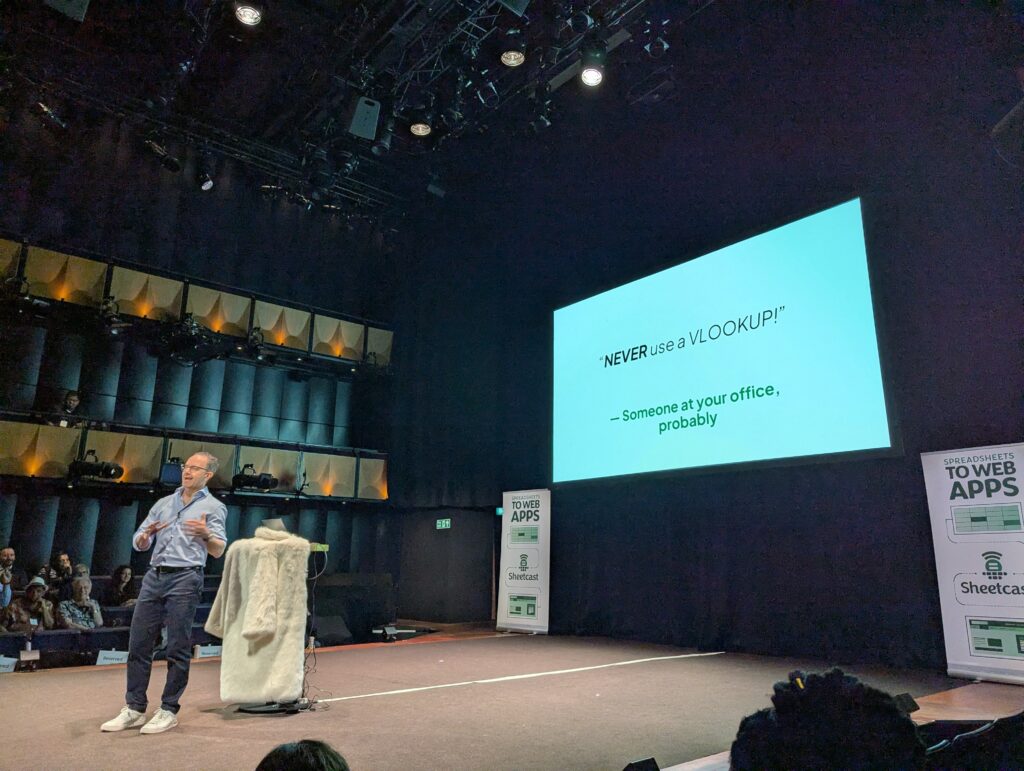
Never say never…
Ian Schnoor’s session gave me lots to think about as a trainer. Through a “personal” story, he illustrated a very real tension that exists when Excel experts want their colleagues to use newer/better features. It’s very easy to intimidate or frighten or annoy when really you just want to help. Ultimately there are lots of ways to achieve the same end for lots of challenges, and whether one function is better than another is sometimes objectively true, but sometimes isn’t. Telling people “never” to use something can build that fear. Or make them think you’re a jerk. Either way, it probably doesn’t help them learn.
In particular, I liked his stepping stones idea about learning (which is relevant to how you design a curriculum). When you’re starting out, you need to build safety and security; later on comes curiosity and flexibility.
Continuing my REGEX journey with Victor Momoh
It was wonderful to meet Victor Momoh in person, and I loved his talk about REGEX. I wrote about the REGEX functions a couple of years ago, and until six months ago I’d made very little effort to learn more about the actual patterns. There are lots of comprehensive sources of information about this on the internet, and it’s one of the areas that LLMs are quite good add because of the volume of training data.
Since I’ve been doing Esports, I’ve been making more of an effort to understand the patterns for myself rather than relying on tools. It’s a lot like learning a language. You can’t just learn it all at once; you have to learn a bit, then practice, then revise, then practice again. Victor’s presentation built up nicely from a couple of simple examples to a few more complex ones, all grounded in real-life problems. It was a great example of how to structure this sort of technical session.
Python is hotter than AI
There were several sessions about Python in Excel, including excellent presentations from Leila Gharani and Carolina Lago. I have a lot more insight about how it could be used as result. There were some AI related presentations, but at least two featured Python as well.
We heard a lot about “probabilistic” vs “deterministic” workflows in this sort of context; using probabilistic LLM tools to create deterministic processes and functions.
It was also interesting in the chat afterwards how many people were saying things like “I really must learn Python” or “I bought a Python course a while ago but haven’t done anything with it yet.” So maybe Python is the twenties version of DAX.
We talk about formulas and functions but not values
Mark Proctor won the “best presentation” award for a session that explored values rather than formulas. Starting with the premise that “Values are so basic that they are advanced”, Mark illustrated a number of examples where Excel doesn’t behave as you think it should do.
A real deep dive into areas of Excel that we take for granted, although I suspect the reason he won was his innovative use of custom functions to play Taylor Swift excerpts every time he generated an error.
How you deliver material is as important as what you deliver
As an Excel trainer, I get to enjoy all the sessions in two ways. Firstly the actual content and secondly, the way it’s delivered. Lots of my notes this year were about presentational styles and techniques.
It’s so nice to feel part of a community
As this was my second year in person, I had already met lots of people in real life before and it felt wonderful to be back in a room with them. Since last year I’ve also taken some tentative steps within the UK esports community, so it was really nice to meet some of them in person for the first time.
Will I see you there next year?
If you want a quarterly newsletter summarising latest developments in Excel and other things I've found interesting or useful, please sign up here. I won't use your data for anything else.